Nevertheless, he died for Christ

Today is the festival of the beheading of St. John the Baptist, who died for what Fr. James Schall called, in a brilliant essay about another martyr to marriage, St. Thomas More, "a small point of doctrine":

We sometimes think that it might be nobler to die upholding the truth of the Incarnation than in upholding, say, chastity, as Maria Goretti did. 

I sometimes joke that my motto is "I will die on all the hills." Some are rubbed the wrong way by it, getting annoyed, like a cat who fails to get the right strokes, with the foolishness of putting up resistance to anything seemingly insignificant, not to mention all the insignificant things. Pick your battles! Pick a big hill to die on! 

Why not just wear a mask? What difference does the kind of lightbulb or stove fuel you use make? Why object to teaching children all the different sorts of perverted ways human beings can use their bodies? Why point out that a beloved hospital, doing so much good, is also mutilating young people? Why not just go along, more silently

Fr. Schall continues:

But the truth is that Catholic teaching is a whole; the denial of any one of its teachings, when logically stretched out, undermines the whole order. And someone will always be found to stretch it out. 

About St. John the Baptist, the Venerable Bede wrote (and we read in the day's Office):

We do rightly revere his memory with joyful hearts, for he stamped with the seal of martyrdom the testimony which he delivered on behalf of our Lord.

There is no doubt that blessed John suffered imprisonment and chains as a witness to our Redeemer, whose forerunner he was, and gave his life for him. 

The Church wants us to delve into the meaning of this witness. What does it mean for us, today, hemmed in as we are by political powers far more insistent than Henry VIII or Herod, if less dramatic; forces that wish to control our speech and thoughts, threatening us with isolation and loneliness if we fail to comply? St. Bede:

His persecutor had demanded not that he should deny Christ, but only that he should keep silent about the truth.

That's all! Herod wished for John only to keep silent about the truth. Surely that is not too much to ask? Why speak out in that way, especially at a party? Why make a fuss? You are not being asked to deny Christ!

St. Bede goes on:

Nevertheless, he died for Christ. Does Christ not say: I am the truth? Therefore, because John shed his blood for the truth, he surely died for Christ.

Truth is coherent, or we are doomed. Fr. Schall:

If no order exists in nature or man, if everything can be otherwise than what it is, no position can be more valid than another. Truth and falsity, good and evil, disappear. Catholicism is left holding to reason in a world that denies its validity.

Marriage -- the gravamen of the martyrdom of both saints, John and Thomas -- might seem like something we can compromise on. Not everyone agrees with us, after all; people have their differences. But, Fr. Schall:

Marriage is, and can only be, of one man to one woman. They are bonded to what is begotten between them. All good social and political order flows from these essential natural truths. Their violation will always lead to personal and societal disorder. 

...  Belloc pointed out that More had no particular love of the papacy at that time. His family and friends did not see why he did not follow the rest of the English hierarchy into the Anglican Church. He did not deny Henry’s political powers. What he died for was the truth of the Primacy of Peter. But this primacy, as such, was not so much the question, as the primacy deciding on a marital case.

Similarly for John, the issue that put Herod in such a tricky position was one that could easily, it seemed to that worldly monarch, be dismissed. What difference did it make who Herodias was married to? 

Besides, Herod had a promise, however rashly made, to fulfill. No going back on that -- and isn't it interesting to observe how on one side, taking a stand is regarded as foolish stubbornness, but on the other, not. It's positively rude of the Baptist to bring things to a... head.

Somehow, we even find ourselves wondering why John didn't wait for a more propitious moment to die, if martyrdom were his goal; and yet we take it for granted that a man in Herod's position simply must carry out whatever irresponsible notion he has proclaimed, even unto beheading an innocent man.

St. Bede: 

But to endure temporal agonies for the sake of the truth was not a heavy burden for such men as John; rather it was easily borne and even desirable, for he knew eternal joy would be his reward.

That's why we speak, why we ought to speak. St. John did die for Christ, in shedding his blood for truth, for a "small point of doctrine," for dying on all the hills. As Fr. Schall says of St. Thomas More: 

He saw that he must “witness” to this “abstract truth,” even if he must stand alone, and lonely, in an obscure cell to do so. Had his “witness” not been so firm, Henry might well have laid claim to rule, not only the city, but the mind.

Hymns do matter: 'Tis Good, Lord, to Be Here!

We need our old hymns*. They are beautiful and uplifting -- and one under-rated quality of time-tested hymns is their, for lack of a better word, information. They are catechetical. They teach, winsomely, without didactic heaviness. Teach is the wrong word, maybe. They just infuse knowledge -- one comes away with understanding.

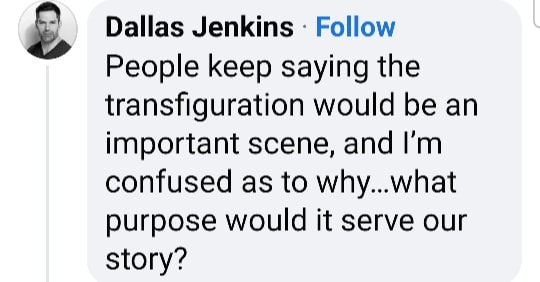
Maybe you saw this revealing post from Dallas Jenkins, producer of the hit TV series The Chosen. 


It's revealing in so many ways. Ignorance, yes, but also a strange lack of humility combined with a determinedly earth-bound vision. Mystery, hiddenness, the cloud of unknowing, the literal voice of God -- these things don't fit into his paradigm of what constitutes a story of Jesus's life. 

"It's just TV, Leila" -- I guess! But interesting how one's Christology will creep in... 

Anyway, back to hymns.

An English-speaking person of yore who worshipped liturgically would have sung 'Tis Good, Lord, to Be Here perhaps two times a year. The melody is lovely and singable (of course -- it's composed by Johann S. Bach; Tune: Potsdam)

If Dallas Jenkins -- not to mention many other Christians, including Catholics -- sang 'Tis Good, Lord, to Be Here, he might begin to grasp the importance of this Gospel. I first heard the hymn at the Anglican Use Mass I went to, on the feast day, some years ago. The economy of expression struck me -- the poetry manages to convey an essay's worth of exegesis in a few verses! 

Yesterday, we sang it at our parish. I noticed: When we sing, we are drawn through the various doctrinal and even historical points without effort. The rhymes are pleasing, the meter peaceful. We are simply led to contemplate the scene and its implications. 

And we are not left without a real spiritual conclusion that we can bring to prayer, in the final brief and poignant phrase.

In short, the hymn offers a fairly complete experience! Why would we abandon this treasure?


 'Tis Good Lord to Be Here

The first stanza sets the scene. We have just heard it in the Gospel reading. Now we consider it again -- what was going on? 

We are there; we survey:

1. 'Tis good, Lord, to be here,

Thy glory fills the night;

Thy face and garments, like the sun,

Shine with unborrowed light.


We consider it more in its detail while savoring it and loving the Lord's beauty. We wonder: why Moses and Elijah? They represent the past.


2. 'Tis good, Lord, to be here,

Thy beauty to behold

Where Moses and Elijah stand,

Thy messengers of old.


And is that all? 

No -- the unity of salvation history in Christ is unveiled here on the mountain: The Past. The Present. And the glimpse into what is in store, which the disciples cannot foretell, though He has been warning them. But for now he reveals a taste of heaven with its glory. We need this reminder, because, like Dallas Jenkins, we are stuck on the flat, horizontal plane and have forgotten that this world is not our true home.

 If we stay with Christ, we are promised redemption.


3. Fulfiller of the past,

Promise of things to be,

We hail Thy body glorified

And our redemption see.


The Transfiguration account (Mt 17:1-9) contains a foretaste of our death, but Our Lord didn't want his disciples to lose hope; he allowed them this vision. They -- Peter -- responded by exuberantly declaring his wish to stay there in that state -- to do something! Perhaps erect booths? Something to keep it!


4. Before we taste of death,

We see Thy kingdom come;

We fain would hold the vision bright

And make this hill our home.


The Lord gently shows him otherwise. Even an illumination on the heights is not enough to fulfill us. Instead, our resolve must be to obey and to beg Him to abide with us for the time we dwell here below. "Come with us to the plain!"


5. 'Tis good, Lord, to be here.

Yet we may not remain;

But since Thou bid'st us leave the mount,

Come with us to the plain.


 Here it's sung to another, also lovely, tune:


 *If we recover the old, we will then have a basis for creativity in the new; but without recovery, we are doomed to an ever-spiraling descent into banality and loss of memory. 

Images matter -- don't be afraid to offer beauty!

Somewhere along the way, in a disastrous development, Catholics let go of the idea that images matter. Contemporary theology is exclusively rationalistic; contemporary opinion is that thinking gets you closer to God; what you see has no effect. Nothing could be less true. 

Beauty matters and images convey meaning, for good or ill.

The rainbow has a meaning. It's a sign of God's covenant with the descendants of Noah, which of course, we are. That covenant, the bow in the sky, is fulfilled in Christ. You can read all about it in this piece by Peter Kwasniewski. He says,

Noah’s Ark is a Scriptural image of the vessel of God’s salvation. Being in the Ark is being in Christ, in His Body, the Church. The raging flood of sin and vice drowns and destroys those who are caught up in it, but those who pass through the waters of baptism—of the death and resurrection of Christ—have their sins washed away and receive the grace of divine sonship. As the human race was preserved for temporal life in Noah and his family, so is it saved for eternal life in the Church.

Since the 17th century, June as been the month of the Sacred Heart of Jesus. I wrote about the devotion with David Clayton in our book, The Little Oratory: This path to love, rooted in the Gospel, was given to us by God as a remedy for the errors of Jansenism, errors of rejection of the human nature of Our Lord, errors of rationalistic legalism and separation from God, under which we still suffer today. I quoted Fr. John Hardon SJ on the topic:  

As formerly Divine Goodness wished to exhibit to the human race, as it came from the Ark of Noe, a sign of the renewed covenant between them . . . so in our own troubled times, while that heresy held sway which is known as Jansenism, the most insidious of all heresies, enemy of the love of God and of filial affection for Him — for this heresy preached that God was not so much to be loved by us as a Father as to be feared as an unrelenting Judge — the most kind Jesus manifested to the nations His Sacred Heart.

His article is well worth reading in full: The Sacred Heart and the Eucharist.

Peter Kwasniewski continues:

He is the Lord of creation and the King of the saints, the unity from which all diversity flows, and to which all must return in order to be natural, right, good, and blessed. This too is what the month of June, traditionally dedicated to the Sacred Heart—since the year 1673, I have seen it said—is meant to remind us of: He loved us first, and by His love, by what He did for us and gives to us, we learn whom to love and how to love. Apart from him there is only demonic unnaturalness, perversity, malice, and misery. [Read the whole thing!]

We still need this devotion, perhaps now more than ever, and we still need the beautiful images that draw us to His Heart and thus to His love. Above all, Jesus loves us and came to redeem us from sin and death. Don't be afraid to embrace His Sacred Heart and show it to the world. This (and other beautiful renditions) is the image we need now:


The way we love those who have fallen into sin is not by means of any political capitulation to ideology in the name of "dialogue" (and don't be taken in by the rhetoric: the LGBT movement is ideology, utterly political, a movement of power, not love). It is by loving our neighbor and, "like one beggar telling another where to find bread,"* offering him Jesus. 


*N.T. Wright


Did you know?

I gave a talk last night to some ladies, some of whom have my books already and follow me closely... yet they didn't know I have a podcast!

Did you? 

You can find it here: Home Truths Society

These are the topics I've talked about so far, and I can pretty much guarantee some thoughts on all the subjects that you may not have expected, nor have heard before:

The Reasonably Stocked and Prepared Life, or Doing a Little More -- How to become, not self-sufficient (so few of us have a homestead, and the advice we hear can be alarmist), but a bit more prepared, without stressing out too much. I especially talk about the importance of breast-feeding your child and encouraging new mothers to breast-feed.

Choosing Children’s Books (and Movies) -- In this episode, I outline the stages of development of the child, and explain what kinds of stories are good for them, when -- and what kinds are not, and can harm their imagination with too much, too soon.

Beauty Will Save the Neighborhood -- Why having your own political sign in your yard, to counteract the ubiquitous BLM/LGBT ones, is not going to help anyone, and what you can do instead.

The Summa Domestica: A Homeschool Retreat for Mothers and Fathers -- How reading my set of books, The Summa Domestica: Order and Wonder in Family Life, is better than a homeschooling conference.

Is Chastity a Ministry? Parents (and pastors) have outsourced to "experts" the formation of their children in love and marriage preparation, and that is not a good thing at all. I urge you to reject sex education, including "chastity ministry," completely.

Don’t Let the World Raise Your Teenager: How to Have Good Culture with Young People -- Why would you carefully curate your youngster's aesthetic and moral education, and then send him, as a teenager, into a world entirely formed by pop culture (or worse)? I help you see what the alternative is!

Why Parish Marriage Prep Fails, with Leila Miller -- Parishes have been offering marriage preparation along the same lines for more than a generation now. Is more of the same a good idea? Leila Miller and I talk about the reasons it is not, and the real reason marriage prep is doomed.

Real Marriage Preparation that Works -- How then should we help couples prepare for marriage? The answer might surprise you. 

Although I find it relatively easy to write a blog post (either here or over at Like Mother, Like Daughter), I find it harder to do podcasts. For one thing, there is no comment function, so I have little idea of whether the listener has benefitted from and enjoyed what I've said! For another, I find I need to visualize my audience. On the blogs, it's easy for me. With the podcast, it's harder.

So let me know what you think! We may make some changes... we may mix things up a bit. We are interested in knowing your response to these podcasts! 


Hypocrisy

My husband, Phil Lawler, writes about the inherent hypocrisy of liberal ideology. 

Usually when critics use the word hypocrisy in the context of political disagreements, they are pointing to the double standard employed, whereby some real offense is winked at because it is committed by an ally, where it would be excoriated if the perpetrator were an enemy. 

Thus, conservatives often lament that an outrage aimed at Christians receives no censure; "Can you imagine if this had happened to a gay person?" they will cry. "It would be all over the front page." Such biases are so common, one must conclude they are not a result of ignorance or oversight. Pointing them out seems to have no effect.

But Phil has a different point here, and it's one worth paying attention to, for self-preservation's sake. He notices that when a Leftist accuses a non-Leftist*  of doing something outrageous, that Leftist is in fact committing the offense. 

Phil has a long list of such examples and I encourage you to read it all, because, as I say, it can help us protect ourselves. Constantly feeling that we have to defend ourselves prevents us from being able to take steps to stop aggression. 

*Not just conservatives -- really anyone just living their lives according to standards held until very recently, most of which we would have called "liberal," in fact. So it's also worth noting how successful Leftists are at shifting the whole playing field.)

The devil... wants you distracted

Lots of talk about the devil these days, and chatter about exorcism movies and so on. It's unsettled me a bit, not because I don't give the devil his due, but, well... I wasn't sure why.

Then Fr. Jerry Pokorsky commented, in this little email exchange* (that included my husband):

From my point of view, a big yawner. Any investment opportunities? Sounds like a great growth stock. Steve Rossetti and the rest will certainly cash in on this one.

The Archdiocese of Boston [and mine, of Worcester] is responding to the Satanic Temple’s “SatanCon” event in Boston with scheduled eucharistic adoration, Catholic devotions, and “intense prayer.”

Here's what would not be "a yawner," he goes on to say: just imagine if you woke up to this news flash:

The American bishops are responding to Biden's promotion of abortion, gay grooming (à la Fr. James Martin, SJ), and genital mutilation (including at many hospitals, including of course children's hospitals, staffed by Catholic personnel) throughout the US Government. They plan scheduled eucharistic adoration, Catholic devotions, and “intense prayer"  -- to give bishops the courage to excommunicate pro-abortion Catholic politicians and others complicit in these moral crimes. The USCCB is preparing a "Fortnight of Excommunication" program of prayer for the purpose.

Ah, right. 

Like many current events that cause a stir along with the immediate, coordinated changing out of avatars and draping of flags, these satan-adjacent activities are a distraction. Not because the devil doesn't exist and isn't out to snatch our souls, but because he does, and he is.

Jimmy Lai and the stand for what one believes in

I recommend this documentary: The Hong Konger. Released yesterday by the Acton Institute, it's a documentary about Jimmy Lai, Hong Kong billionaire who literally went from rags to riches -- and is willing to lose everything to stand for the truth.

Jimmy Lai, a convert to Catholicism, could easily have left Hong Kong when it became clear that with the handover to mainland China and the CCP, his liberties and his fortune would be taken away. Perhaps because he is preternaturally adventurous, having stowed away from the mainland at age 12 and made his fortune in the "Fragrant Harbor," perhaps because his personality is both stubborn and deeply moral, he refuses to stop speaking out about the loss of freedom and what it means for the human spirit.

This documentary has some gaps, but remains a moving story of Jimmy Lai's life and a good introduction to the history of Hong Kong and its fate as a British colony and then a troublesome thorn in the side of the Chinese Communist Party, which has chosen to stifle its vigor and democratic system with oppressive laws and raw acts of power. 

These days it's not easy to find good material for young people so that they can become acquainted with current events. The Hong Konger is suitable for teens as well as adults, and I think it's important that everyone watch it -- not only for its educational value but for an introduction to a man of integrity and courage. 


Michelangelo's David and our warped sense of what is appropriate

 I have to do a bit of cross-posting! 

Sometimes on my blog Like Mother, Like Daughter, I comment on a story -- and what I say could just as well go over here. 

So here's what I said, with a little extra, about Michelangelo's David; commentary that arose due to an eruption of a not-uncommon frisson over the question of its nudity:

Hillsdale is right here: Hillsdale College breaks ties with Tallahassee school over Michelangelo’s ‘David’ controversy

We have to understand what culture is, so that, for one thing, we can understand what pornography is, and reject it. The David is the very pinnacle of high art because it radiates the truth of man as he is meant to be, as he was created by God. 

What’s notable about the nude form as depicted in the statue (and other such sculptures of which it is the apotheosis) is the perfect balance, proportion, and hierarchy of humanity, reason, and spirit. Yes, we (and children) see his genitals. 

They are, in ancient fashion, “at rest” and minimized in comparison with his chest (his courage and thumos) and his noble head (his mind, Reason). We need precisely this depiction — among other qualities (its beauty, its truth about the actual Biblical figure, from whom Our Lord received His own manhood, ultimately), as an image against which to measure degraded ones.

Here I will add: 

The question might arise whether it is not simply a matter of keeping private parts, well, private. I appreciate that idea and normally am in favor of it, but, given that this statue and many others in the Greek and Roman classical tradition, which the Renaissance artist Michelangelo was recovering in his own fashion, have for centuries been on display in public places where children abound, and given that our age is hardly the most prudish of these, perhaps it is we whose sensibilities are not quite calibrated in the way they ought to be.

Previous generations thought that the message I express here about the relative proportions of the parts of the human body in the figure of David, "a man after God's own heart," was important enough to override concerns about modesty. The ancients thought that modesty, precisely in the sense of fittingness, paradoxically demands our gaze

We today have a lot to learn about all these subjects if we hope to recover truths previously known. We are far from being experts on the topic; we are in fact, deformed, and we ought to question our reactions continually, as we have lost all sense of normalcy; we, whose culture abounds with casual pornography, certainly have no inkling of what decency could possibly be. 

Let the works of the past be known and not hidden away. We need all the help we can get.


Remembering the great Cardinal Jozsef Mindszenty on his birthday

From a piece posted by my husband: 

"Today is the birthday of the late, great Cardinal Jozsef Mindszenty, and an appropriate time to mention that Ignatius Press has issued an impressive new edition of his Memoirs [affiliate link], with an introduction by Daniel Mahoney, a timeline of his struggles with Hungarian totalitarianism, and 70 pages of relevant documents. The book does a valuable service, to ensure that the story of a man who was once the world’s leading symbol of Catholic resistance to Communism does not pass lightly from the public memory.Imagine a Pope (Pius XII) excommunicating everyone involved in the show trial of a victim of Communism, Cardinal Mindszenty."

Imagine a Pope (Pius XII) excommunicating everyone involved in the show trial of a victim of Communism, Cardinal Mindszenty.  

It is possible but barely conceivable today. Yet so needed: Think of all the medical personnel involved in immoral acts and crimes against children, including the unborn; think of politicians using their power to keep abortion legal and undermine marriage!

Imagine a Pope (Paul VI) lifting that excommunication and betraying that victim all over again.

Possible and sadly, believable.

A simple question for defenders of "THE Council"

Again and again, those who love the Traditional Latin Mass, the Mass supplanted by the Novus Ordo of Paul VI, are required to answer some form of the question, "Do you uphold the Second Vatican Council as a work of the universal Church, ratified by her bishops? Do you view it as valid? Do you accept its teachings, even though we agree that it was not dogmatic, as its own documents assert?" 

Anyone who is somewhere on the scale from "the Council in its evident results represents a super-dogma and I think it should be re-examined with a more critical eye" to "the Council was fine but was reduced to an amorphous 'Spirit' that makes me uneasy and has not quite borne the fruit it claimed would result from its implementation" finds himself required to preface any opinion or critique with an obligatory recitation of his credo, his "I believe" -- not in Jesus Christ, but in the Council.

But let us remember: The hand that strikes also blocks. The time has come to shed this defensive posture.

Martin Mosebach, in his First Things article responding to the promulgation of Traditionis Custodes in 2021, offers his usual insightful commentary. But perhaps the most important insight to help us overcome a fatally defensive position is this one:

"Francis appears to sympathize with the “hermeneutic of rupture”—that theological school that asserts that with the Second Vatican Council the Church broke with her tradition. If that is true, then indeed every celebration of the traditional liturgy must be prevented. For as long as the old Latin Mass is celebrated in any garage, the memory of the previous two thousand years will not have been extinguished."

A Christian ought to ground his faith in tradition. The Church Fathers are utterly unanimous on this. St. Athanasius exhorts us to have recourse to Scripture and to "the very tradition, teaching, and faith of the Catholic Church from the beginning, which the Lord gave, the Apostles preached, and the Fathers kept.  Upon this the Church is founded, and he who should fall away from it would not be a Christian, and should no longer be so called” (Ad Serapion 1:28)

Therefore, let those who seek to suppress doctrinal and liturgical tradition answer the simple question: "Do you follow a hermeneutic of rupture? Do you hold that Vatican II broke with tradition?" 

Every thing they say must be prefaced with an answer to this question, and if the answer is "No, I do not," then every subsequent statement must be shown to be in continuity with tradition, as outlined in Sacred Scripture (see the letters of St. Paul) and the Magisterium. Or it must be rejected. 

It's a simple question. The conversation starts there. "Does Vatican II represent for you a break with tradition?"

Conscience is what makes the man

I wrote a piece for The Catholic Thing on Cardinal McElroy and the trap of rejecting the primacy of conscience just because he says he's for it. Spoiler, he is not.

Read it all here (mine is the second piece -- feel free to contact the editor and ask for it to be posted as a separate link so that you can more easily share it!): McElroy's Conscience Trap